



Hardwired vs Plug-In Pendant Lights: Which to Choose
DrMaker3DChoosing between hardwired vs plug-in pendant lights comes down to three things: whether you own or rent, how much you want to spend on installation, and where the nearest ceiling box or wall outlet sits. Both give you the same shade and the same glow. The difference is entirely in how power gets to the bulb. Here is how to decide, with the real numbers and trade-offs.
What hardwired and plug-in actually mean
A hardwired pendant connects directly to the electrical box in your ceiling. The wires join inside the box, the canopy covers the connection, and there is no visible cord running to an outlet. You control it from a wall switch. It is the built-in, permanent look most kitchens and dining rooms are built for.
A plug-in pendant hangs from a hook and runs a fabric or PVC cord along the ceiling and down the wall to a standard outlet. Many plug-in cords include an inline switch, and you can put them on a smart plug for app or voice control. Nothing behind the wall changes, which is why it is the renter-friendly option. If you want the full walkthrough, see our guide on how to hang a plug-in pendant light with no wiring.
When a plug-in pendant is the right call
Reach for plug-in if any of these are true:
- You rent, or you do not want to open up the ceiling.
- There is no existing ceiling box where you want the light, but there is an outlet nearby.
- You want to hang it this afternoon without an electrician or a permit.
- You like the exposed-cord, casual look over a nightstand, reading nook, or bedroom corner.
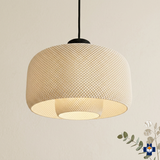
A swag hook and a plug-in cord kit will hold a lightweight PLA shade easily. Our shades run roughly 4 to 12 ounces depending on size, so a basic ceiling hook rated for 5 to 10 pounds has plenty of margin. The CLARA woven pendant ships with a black or white plug-in kit option and works well swagged over a bedside table.

When a hardwired pendant is worth it
Choose hardwired when:
- You own the home and want a clean, cord-free ceiling.
- There is already a ceiling box, often where an old fixture used to hang.
- You want wall-switch control, or a row of pendants over a kitchen island.
- The light is a permanent part of the room's design.
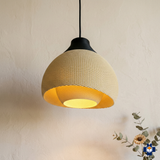
Swapping a hardwired fixture into an existing box is a common weekend job: turn off the breaker, disconnect the old fixture, connect matching wires (black to black, white to white, ground to ground), and mount the canopy. If there is no box, or you are unsure, hire a licensed electrician. That is the one place we tell people not to improvise. The MARINA geometric pendant comes with a black or white hardwired kit and makes a strong single statement over a dining table.

Hardwired vs plug-in pendant lights at a glance
| Factor | Hardwired | Plug-in |
|---|---|---|
| Best for | Homeowners, permanent installs | Renters, quick changes |
| Cord visible? | No | Yes, run to an outlet |
| Control | Wall switch | Inline switch or smart plug |
| Install time | 30 to 60 min with a box | 10 to 15 min |
| Typical extra cost | $0 to $150 if an electrician is needed | $0, just a hook |
| Reversible? | Not easily | Yes, no marks left behind |
Cost and effort, honestly
If you already have a ceiling box, hardwired costs you nothing extra and about an hour. If you need a new box run, an electrician typically charges $100 to $300 depending on your area and ceiling access. Plug-in costs only the price of a $5 to $15 swag hook, since the cord kit is included with the shade. For most renters and anyone avoiding drywall work, plug-in wins on both counts.
Can you switch later?
Yes, and this is the part people miss. The shade is the same either way. Our pendant kits differ only in the cord and canopy hardware, so a shade you buy today can move to a new setup down the road. Rent now with a plug-in kit, then convert to hardwired when you buy a place. If you are still choosing a shape or size, browse the full pendant light collection first and decide on the wiring second.
One safety note for both
Whether hardwired or plug-in, use an LED bulb only. LEDs run cool, usually under 95°F at the surface, while incandescent and halogen bulbs get far too hot for a printed shade. A 6 to 9 watt LED (40 to 60 watt equivalent) gives plenty of light and keeps everything well within safe temperatures. Stick to LED and the shade will last for years.
Still deciding on style rather than wiring? Our table and desk lamps give you a plug-in glow with zero installation at all, which is the simplest path of them all.