



How to Choose a Lampshade Shape: Drum, Dome, Taper & Custom Compared
Rich SanzoPick two identical rooms, hang a drum pendant in one and a tapered cone in the other, and they'll feel like different houses. Shape is the single biggest decision you make about a light fixture — bigger than color, bigger than size — because it controls both the silhouette you see all day and the pattern of light the shade throws at night. Here's how we think about it in the studio, shape by shape.
Drum: the reliable modernist
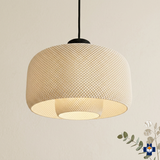
Straight sides, equal top and bottom. The drum is the most forgiving shape in lighting — it reads mid-century over a dining table, Scandinavian in a bedroom, and industrial in a kitchen depending on the texture and color you pick. Because the walls are vertical, light spreads evenly up and down, giving you a soft ceiling glow and a generous pool of light below. If you're not sure what you want, start here. Our LOLA is a drum with a fine woven mesh, and it's our bestseller for a reason.

Tapered: the classic with direction
Wider at the bottom than the top (or the reverse). Tapering aims the light — a bottom-heavy taper pushes light down onto a table or counter, which is why classic kitchen pendants taper. The steeper the angle, the more focused the pool of light. Flip it (wide at top) and you get something architectural that washes the ceiling instead.
Dome: soft and intimate
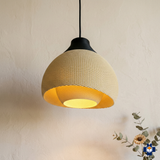
A dome hugs the bulb and sends nearly all its light downward in a warm, contained circle. It's the shape for reading corners, bedside pendants, and bar carts — anywhere you want a defined glow rather than all-over brightness. Domes feel calm. Pair one with a warm LED bulb and a textured finish and the shade itself becomes the mood.

Bulb and belly shapes: the personality hires
Shades that swell in the middle — think of our boho pendants like MARISA — throw light in two directions at once: down for function, and through the belly's texture for atmosphere. These are statement shapes; they work best where they have room to breathe, like over a kitchen island or in a stairwell.

Faceted and polygon: light with edges
Flat panels instead of curves. Facets catch light differently on every face, so the shade shifts as you walk around it. A hexagonal or octagonal cross-section reads geometric-modern; a triangle or square is bold and graphic. If your room is full of soft shapes, one faceted pendant is a great counterpoint.

Custom: when the room asks for something specific
Sometimes none of the above is quite it — you need a long neck to clear a shelf, a wide flare to cover an off-center junction box, an oval so the shade doesn't crowd a narrow hallway. That's exactly why we built our Lampshade Designer: you drag the silhouette yourself, pick any cross-section from round to eight-sided to hand-drawn, add texture, and see the price update live. The designer checks every curve for printability, so anything it approves, we can print in 30+ colors.
Quick cheat sheet
- Dining table or island: drum or bottom-heavy taper, sized about 1/2 to 2/3 the table width.
- Bedside or reading nook: dome, hung low (about 50–60 cm above the surface).
- Entryway or stairwell: belly or faceted — somewhere a statement earns its keep.
- Narrow spaces: oval or slim custom silhouette so the shade doesn't crowd the walkway.
- Renter with no wiring: any of the above with a plug-in cord kit — see our no-wiring hanging guide.
Still torn? Open the designer and try two or three shapes with your room in mind — it's free to play, the 3D preview does the imagining for you, and every design shows its real price as you go. Or browse the finished collection and let a shape pick you.